
To prevent spices from clumping, my aunt used to put grains of white rice in her salt shaker—a trick that fascinated me as a child. Back then, I had no idea the rice served such a clever purpose. (Fig 1) Instead, I thought she was a bit eccentric. This is the same aunt who stored plastic bags of single-serve grape jelly and ketchup packets from Horn & Horn, a Baltimore staple, in her refrigerator.
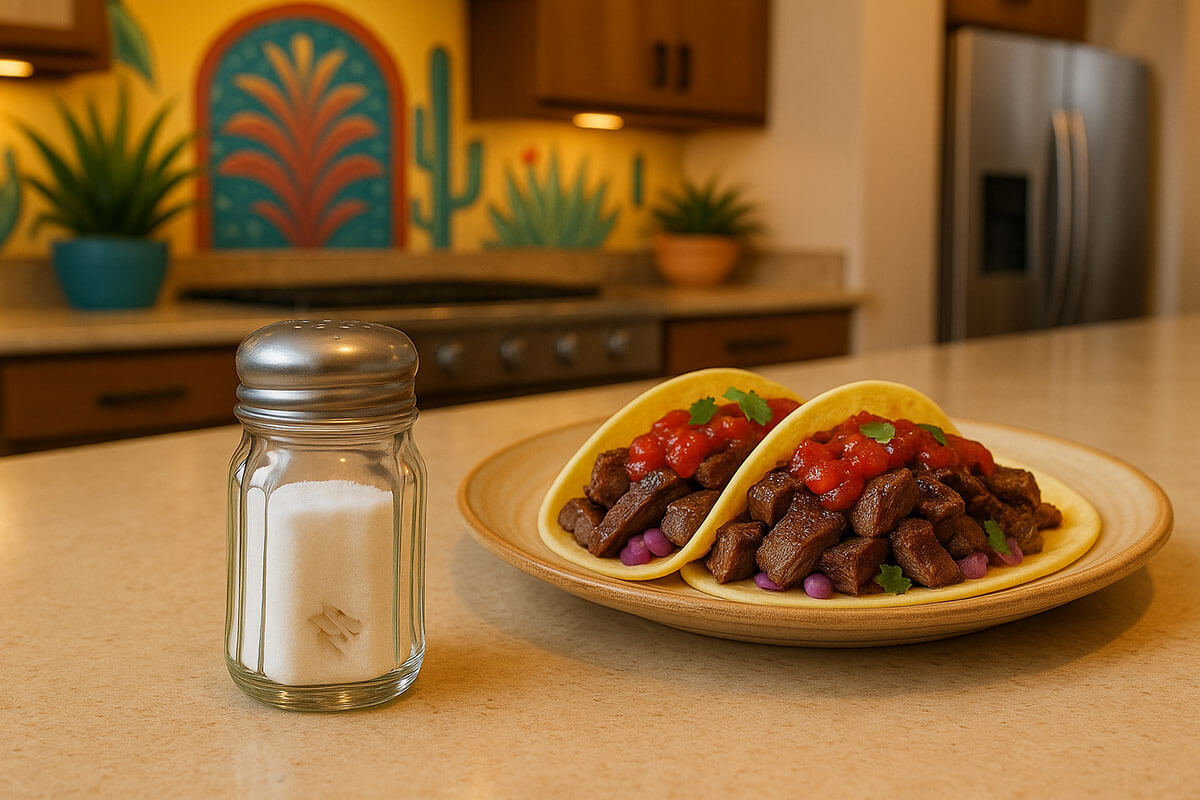
Has this ever happened to you? You reach into your spice cabinet and grab a bottle of garlic powder. As you remove the lid and give the bottle a rigorous shake, nothing comes out of it. After examining the bottle, you notice that the ginger has coagulated into a solid mass. You grab a small knife, break up the clumps, and get back to cooking.
What caused the garlic powder to clump? There are several possible reasons, with the most common being a humid environment. Many spices (salt, garlic powder, onion powder) naturally absorb moisture from the air. It’s common in areas of the country that experience high humidity because of their proximity to large bodies of water. The problem with spices absorbing moisture can be compounded when the jar is not tightly closed, allowing humidity to sneak into the bottle.
Additionally, spices milled to a finer consistency are more prone to absorbing moisture. The milling process can create microscopic irregularities in the spice particles. These irregularities create spaces that can collect moisture. Because of this (among other reasons), ground spices typically have a shorter shelf life than whole spices.
Tips to Prevent Spices from Clumping
Clumping is mostly an annoyance and an inconvenience, especially when you’re in a hurry to prepare a meal after a long day at work. (Fig 2) However, excessive moisture accumulation in a bottle of spices can reduce their shelf life.

Follow these tips to help prevent spices from clumping.
- Avoid storing spices near heat sources, for example, a range or microwave. Condensation can form inside the jar as the air cools. Spices are sensitive to both temperature and light, both of which can shorten their shelf life.
- When using measuring spoons, make sure they are dry before dipping them into the spice jar. Any moisture on the spoon can transfer to the spice bottle, causing the contents to clump. Better yet, rather than dip a measuring spoon into a jar, pour the spice from the jar onto the spoon.
- Add a few grains of rice to your spice jar. Because rice is hygroscopic, it will absorb any moisture inside the jar. Rice also contains a fair amount of starch molecules, which bind to water molecules. With moisture locked away inside the rice, the contents of your spice jar will flow more evenly. It is similar to the process of placing a mobile phone that has fallen into water into a container of rice.
- Make sure that before you return your spice to your pantry, the lid is tightly closed. A lid left slightly ajar can allow humidity (moisture) to enter the jar. Proper storage of spices is key.
- Steam released by boiling can cause moisture to accumulate in the bottle. This is especially true, for example, when you shake chili powder over a pot of simmering soup. Use a measuring spoon or place the spice in the palm of your hand before putting it in the pot.
- Some spices with a high oil content, such as paprika, chili powders, and curry powder, contain natural oils that can clump, primarily if they have not been used recently. The oils, when exposed to moisture, can cause the spice particles to adhere to one another, forming small clumps.
- If nothing else works, you can try adding a food-grade silica gel packet to a jar of spices. Silica gel packets are safe to use with food and can be recharged by drying them out.
The clumping of spices does not affect the flavor of the spice or mean that your spices are no longer good (unless they are very old). It just means you’ll need to do a little work to get them out of the jar.
Ask Alejandro!

Have a question or comment about something you just read? Send me a message and let me know how I can help you.
Message Me