Innovation can be a difficult proposition in the spice and seasoning space. It is a mature industry. While flavor development presents an opportunity to introduce novel concepts, there are a finite number of spices (about 30) in the world. Creating a new equivalent to lemon pepper or Cajun seasoning is unlikely. Before exploring potential innovations in the industry, let’s examine the concept and definition of innovation.
Innovation has been a buzzword across all industries for many years. It is a mandate, a goal, or a concept of interest for organizational leaders. Many think that innovation is necessary for organizational success. That’s true for many companies in various industries, particularly those that experience rapid technological, process, product, or service changes.
Not all organizations can be innovative. Innovation requires organizational commitment and discipline. The right kind of people must be hired, and their innovative talents must be developed and allowed to flourish. A culture of innovation must be created, with support and guidance from every level within the organization. Trial and error are required. A tolerance for and encouragement of failure must be adopted. Collaboration must be promoted, and resources should be assigned and willingly lost in pursuit of the mission.
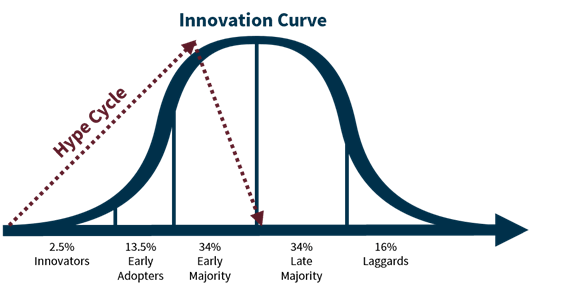
For many organizations, it is perfectly fine not to reside in the “hype cycle” zone of the innovation curve. It is, at best, exceedingly difficult to become innovative when the culture, people, and organization commitment don’t support it. Many organizations succeed by following innovators. This is how markets expand – copy innovations and do it more efficiently, cheaper, or at scale. Understanding your organization’s place on the innovation curve and being realistic about whether your organization is or can be innovative is a crucial part of strategic planning. It determines the level of innovative support required from vendor partners.
What is innovation? Broadly, it is the creation of value. It is developing a unique idea that introduces a new way of thinking to the market.
Innovation – Disruptive and Sustained
There are two kinds of innovation – disruptive and sustained. Disruptive or breakthrough innovation typically happens when a small business challenges a large business and creates value that captures a market segment. Examples of disruptive innovation include the Tesla car company and Amazon.
Sustained, or incremental innovation, enhances an organization’s processes and technologies to improve its product line for an existing customer base. It is pursued by incumbent businesses that want to stay atop their market. Examples include a next-generation computer chip or an improved laundry detergent formula.
Sustained innovations are sometimes dismissed in favor of disruptive innovations, which are perceived as having greater value. However, both types of innovation are valuable to organizations.
Innovation and Improvement
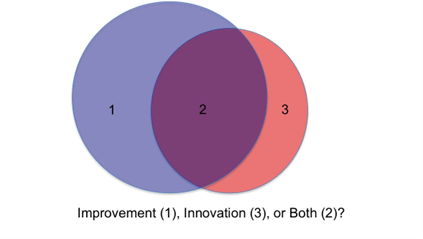
It is instructive to distinguish between innovation and improvement, as these concepts are often used interchangeably. Not all innovations are innovations, while most innovations are improvements. However, some innovations are not improvements. The relationship looks like the figure below.
Improvements abound in the spice & seasoning industry, but in what areas can innovation occur?
- Culinary innovation. This is the creation of new or different flavor profiles. It is accomplished by combining spices and/or ingredients in unique ways.
- Functional innovation improves seasoning performance. Examples include anti-clumping ingredients or technology, reducing dustiness, or achieving a more uniform dispersion of ingredients.
- Health innovation. This improves the health benefits of a seasoning blend. It could include salt substitution, a vegan recipe, or the infusion of vitamins or other healthy ingredients.
- Packaging innovation. Packaging options range from bulk super sacks, boxes, food service containers, retail containers in glass or PET, pouches, canisters, and tins. Sustainability and eco-friendly packaging are growing trends. Innovations can occur with container sizes, composition, and lid configurations.
- Labeling innovation. This is the face of your brand and is arguably at least as important as the product itself. It could include artwork and color combinations, adhesion onto the container, supplemental information such as usage and recipes, and website links. Pre-printed pouches offer an easy, low-cost labeling alternative.
- Production innovation. How are products blended and packaged? Can innovative production techniques or technology be employed to accelerate processing and lower costs? This could include something simple, such as staging ingredients to minimize movement to a blender or production line or introducing automation that allows packing into a new container.
- Quality innovation ensures that food products are safe for consumption. This includes eliminating adulteration, detecting foreign matter, and controlling allergens.
There are numerous opportunities for innovation in the spice & seasoning industry. It’s likely that innovations are in process that haven’t been mentioned here and that we haven’t dreamed possible. That’s the nature of innovation.
Vanns Spices strives to be innovative in the areas described above. We thoughtfully approach innovation and improvement opportunities to drive value for customers. Our mission is to support our customers and help them grow their brands. Innovative solutions are an important part of our value proposition.
Ask Alejandro!

Have a question or comment about something you just read? Send me a message and let me know how I can help you.
Message Me